Side project
The Pear Game
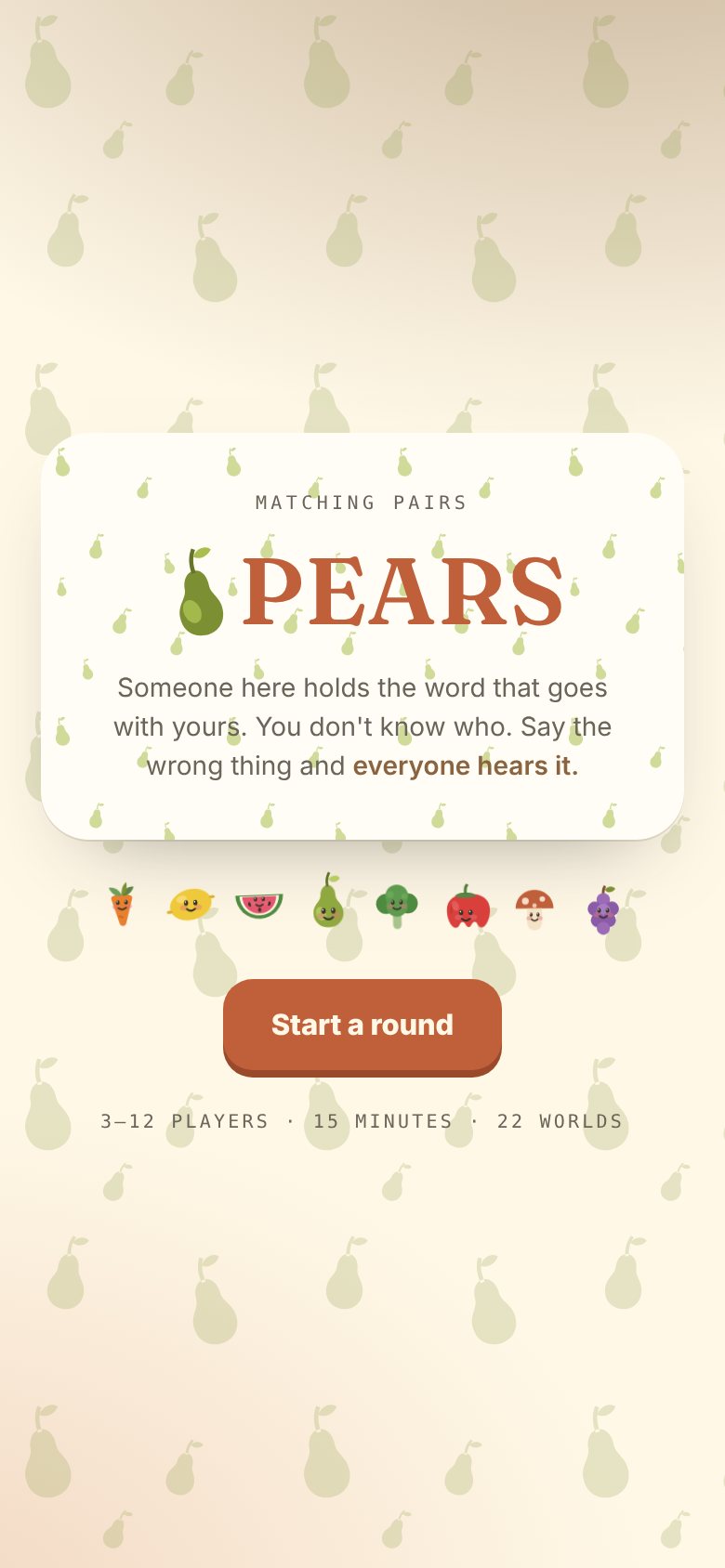
Pears is a pass-the-phone party word game for 3 to 12 players. Everyone holds a secret word, and somebody at the table holds the word that goes with yours.
A working prototype I built as a Claude artifact. It is not publicly playable yet, so this page shows screenshots instead.
- 3 to 12 players
- About 15 minutes
- One phone, nothing to print
Screenshots
What it looks like
Taken from the latest build (22 September 2026), played through once with six made-up players in The Kitchen. Tap a screenshot to see it larger.
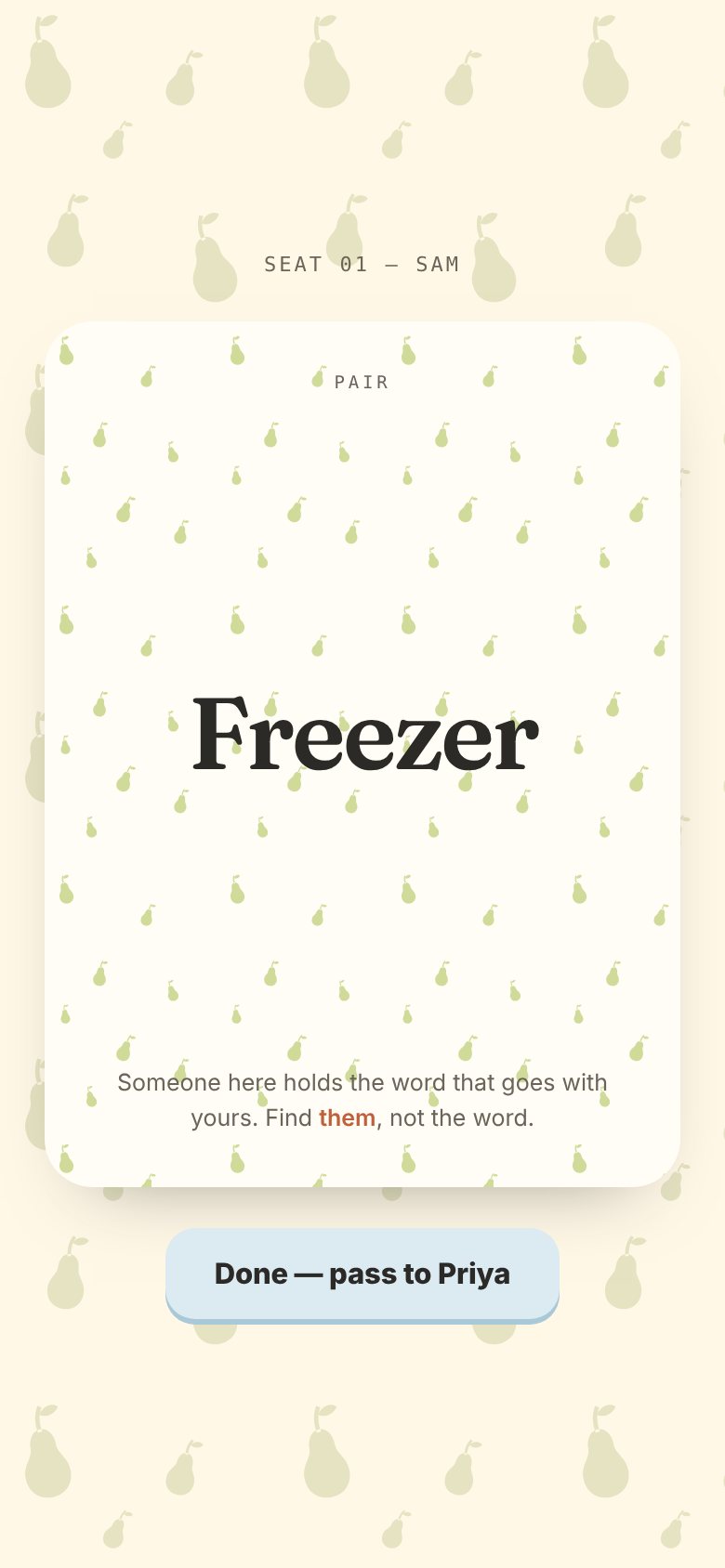
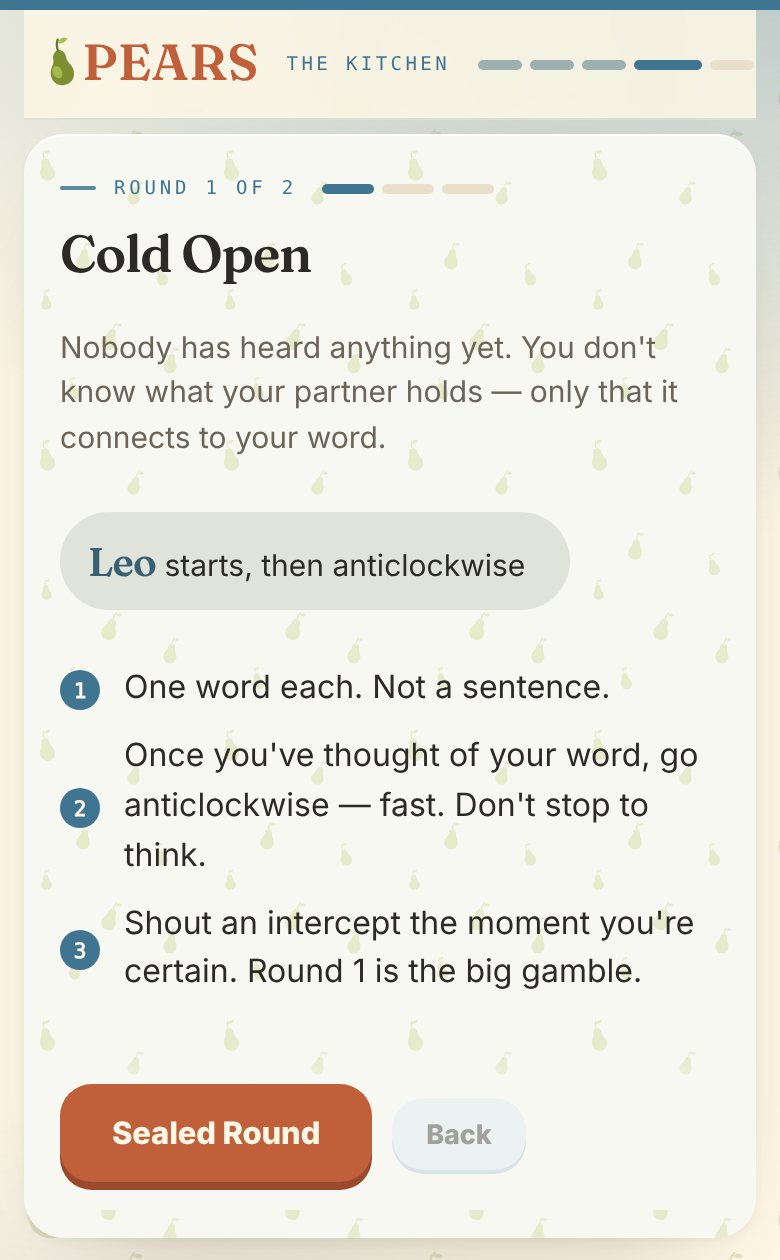
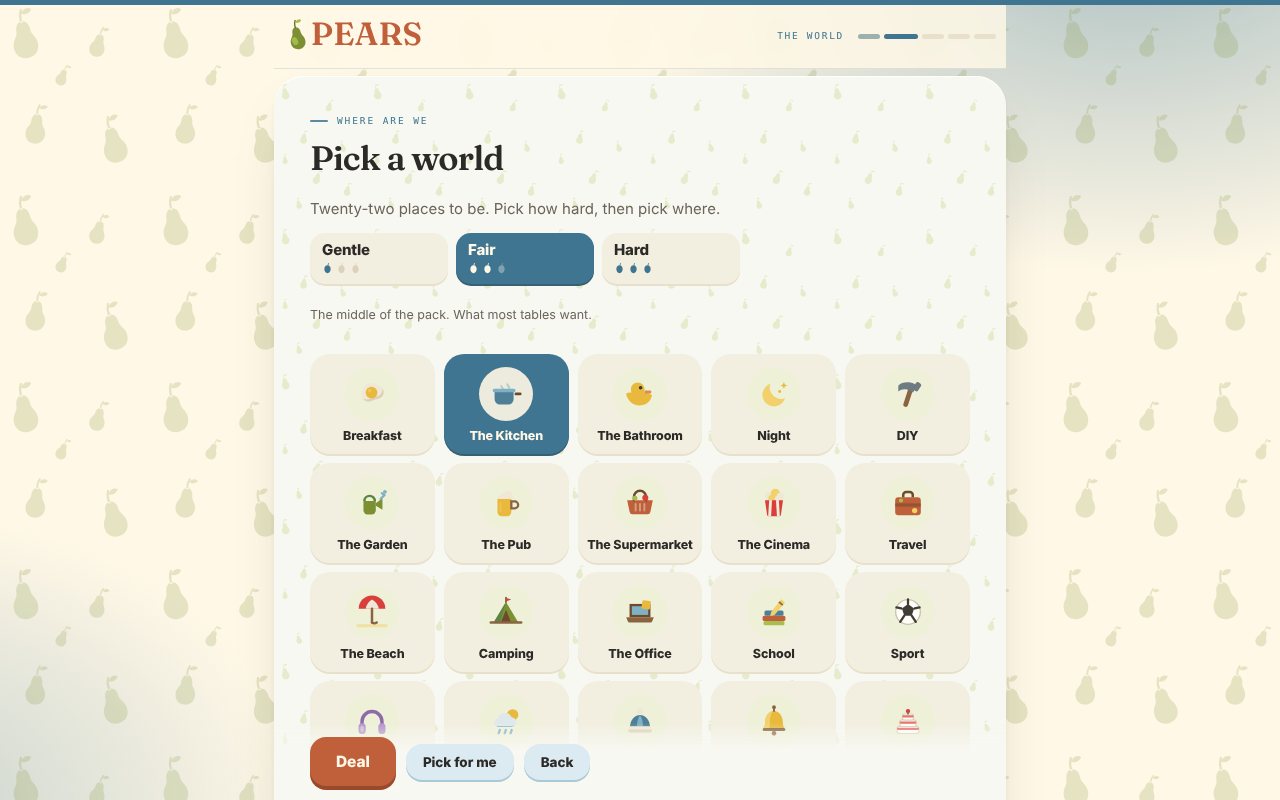
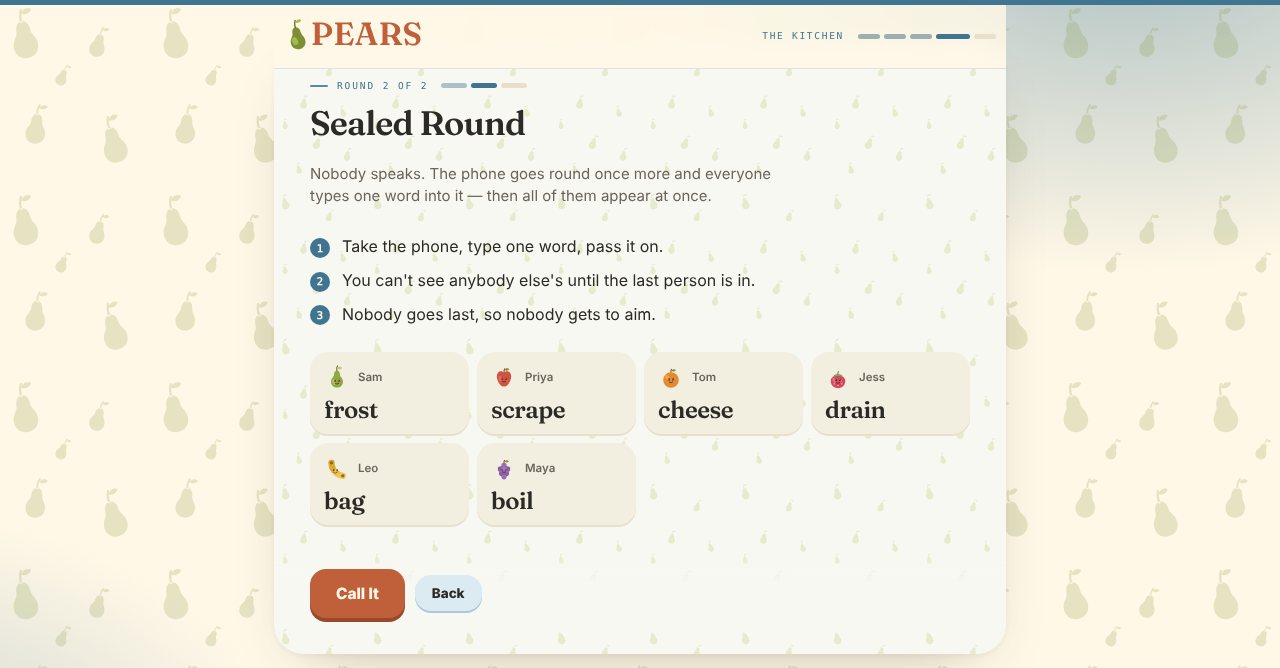
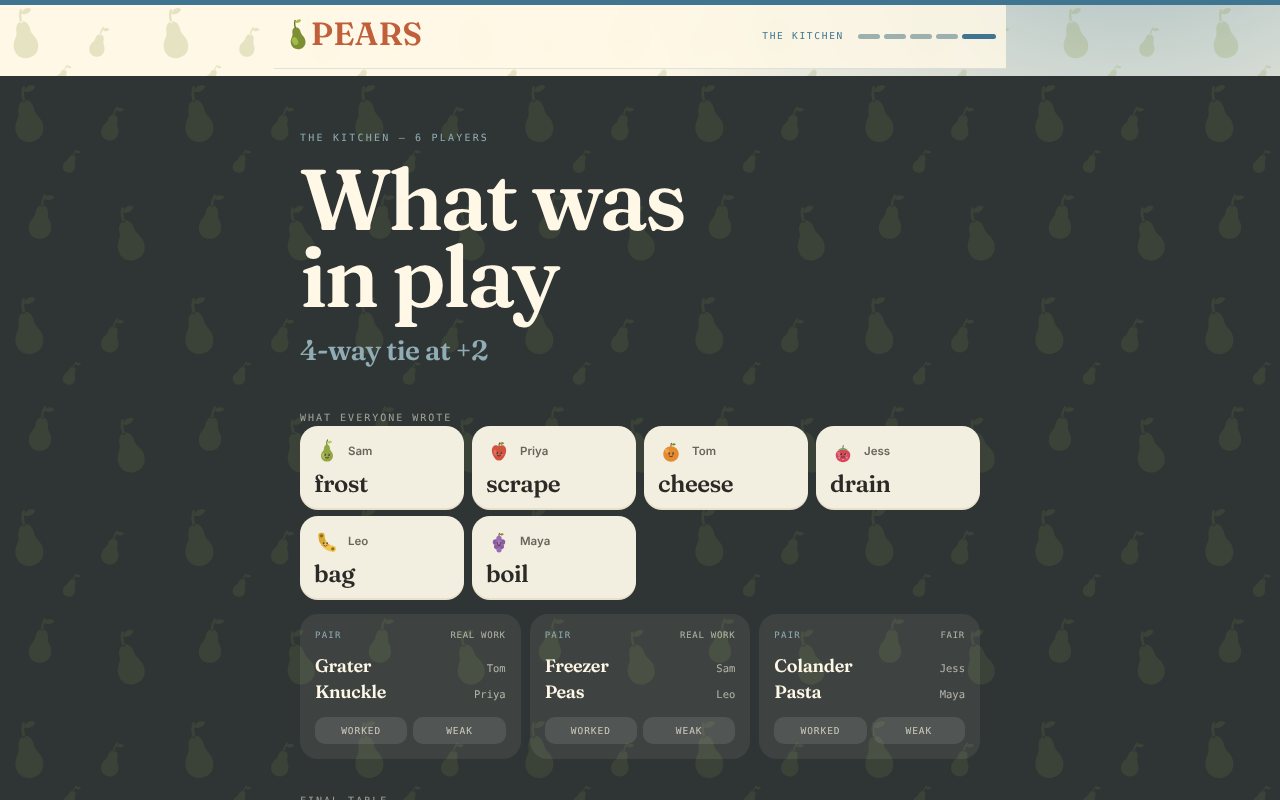
6 screenshots of the prototype. The game itself is private for now, so there is nothing to play here yet.
How it plays
Find your partner without telling everyone
Everyone gets one secret word. Two of you hold words that go together, like Kettle and Mug, but neither of you knows who the other is. The only way to find out is to say things out loud, in front of everybody, including the people trying to catch you.
-
Set up
Pick how many are playing, give everyone a fruit or vegetable character, then choose a difficulty and a world. Each player takes the phone, holds the card to see their word, and passes it on.
-
Cold Open
One word each, out loud, going anticlockwise at speed from a starter the app picks. Nobody has heard anything yet, so it is a guess as much as a clue.
-
Sealed Round
The phone goes round once more and everyone types one word without seeing anyone else's. Then all the clues appear at once.
-
Call it
On three, everyone points at the person they think is their partner. Pointing at the same moment means nobody can copy somebody else's guess.
-
Reveal
One person taps in any intercepts and who pointed at who. The app checks the deal, shows what was in play and works out every score.
What makes it interesting
-
Intercepts
At any point you can shout out somebody else's pair. Get it right in Round 1 and you take what they lose; get it wrong and it costs you just as much. One call per player per round.
-
Nobody goes last
Speaking last used to mean hearing every clue first and aiming a narrow one at your partner. The sealed round fixes that, and it only works because there is a phone in the middle of the table.
-
No numbers on screen
Points run on one scale from minus 2 to plus 3, but the table never sees them during play. Finding each other and getting caught still beats saying nothing.
-
The decoy
With three players, two hold a real pair and the third holds a word that only looks like it belongs. The decoy wins by getting named anyway.
-
Graded words
Every word group is graded from 'gives itself away' to 'real work', and the dealer builds a board at the difficulty the table chose, without accidental links between groups.
-
House rules
Optional twists you can switch on, such as a shot clock on every turn, a word leaked by the app in Round 2, or a dare for whoever finishes last.
How it was made
From a working title to a working prototype
I wanted a one-phone, fifteen-minute game because we are always on our devices. Bringing family and friends together around a conversation is fun, and it can be exhilarating.
I built it as a Claude artifact: a small web app made in conversation with Claude and changed one version at a time. It went through more than a dozen numbered versions.
-
Early on
Intercept becomes Pears
The working title was Intercept, after the move where you call out someone else's pair. That named the spoiler rather than the game. Pears is better: say it out loud and it sounds the same as pairs, so the name explains the rules.
-
Checking the name
Before going further, I looked into whether the name was usable.
-
Before 21 September
Testing on paper, fixing in the app
A paper table-read found four faults, and each one changed the game. Going last was an advantage, so the starter isn't picked until the round opens and Round 2 became sealed. Half the pairs solved themselves, so every word group got a grade. Intercepts could be spammed, so it is one call per round. The scoring did too many jobs, so it became one six-number scale that the app works out. I also cut a step where every player tapped their name to confirm they had a clue: clever, but it made a party game feel like a form.
-
The pitch deck
I wrote a 14-slide deck setting out the idea, a round from start to finish, the scoring, the word pack and, just as plainly, what is not solved yet: Round 1 still has a turn order, and nobody knows yet whether typing on a phone mid-game feels like a climax or like admin.
-
The latest build
The version in the screenshots: 22 worlds, 176 word groups and 396 words, three difficulty levels, 24 fruit and vegetable characters, a three-player mode and a set of optional house rules.
-
Where it stands
Not played at a real table yet
Nobody has played it at a real table yet. It is quite complex, and there are still technical areas to develop.
-
Next
Get it on a table
The next step is one real session with six people, the size it is built around, to see whether the rules and the scoring hold up when people actually play.
If you run a games night and would like to try Pears when it is ready, get in touch.
Contact me